

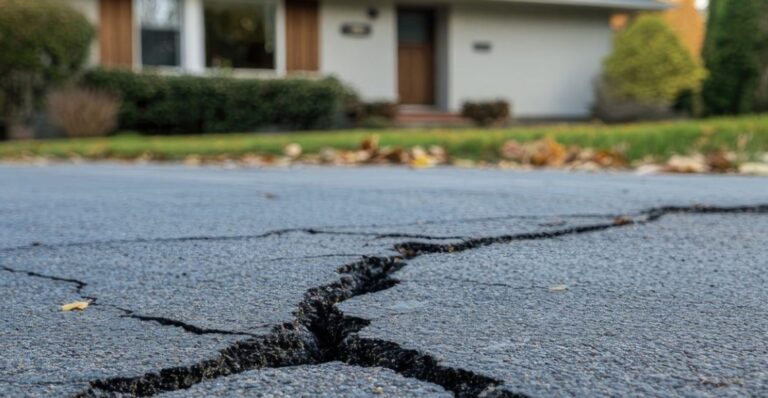
Concrete driveways naturally create the first impression your guests see. Because of weather exposure, heavy vehicle loads, and regular usage, the driveway slowly starts to get damaged. This includes small, shallow cracks, uneven surfaces, and broken areas that you often notice when parking your car. Many people don’t get these issues fixed in time, which leads to long-term weakness. In such situations, it becomes uncertain whether the driveway needs repair or replacement, because some issues can’t be fixed with repairs alone.
A well-maintained driveway increases your property’s value and is very important for safety and curb appeal. Today, we will highlight the indicators that clearly show it’s time to replace your driveway.
Deep or Widespread Cracks
When a driveway is new, its surface is smooth, solid, and even. But over time, its condition begins to change due to temperature shifts, heavy vehicles, and moisture, all of which affect its lifespan. Among the driveway’s condition issues and warning indicators, deep or widespread cracks are a strong sign that the concrete is no longer stable.
When cracks become so deep that their lines can be seen running across the entire driveway, it shows that the damage has reached the foundation. These cracks are repeatedly interconnected, indicating that the base beneath has also moved or fixed.
Widespread cracks signal that the driveway is reaching the end of its lifespan. No matter how many times you add patches, they often reopen after a few months because the underlying problem remains unfixed. Deep cracks allow water to seep in, and with the freeze-thaw cycle, the damage increases even more.
Water Pooling or Drainage Issues
Water pooling is one of the most common and noticeable problems in a driveway. When rainwater gathers on the driveway for a eternity, it’s a signal that the surface is no longer holding the proper slope. Usually, a driveway is built with a lean angle so water can drain smoothly. But when the concrete settles, the soil downshifts, or the base cripples due to cracks, surface water begins to form.
This doesn’t just impact the appearance it also traps water inside the concrete and gradually weakens the surface. Eventually, this worsening accelerates, lead to more problems like gaps, spalling, and an rugged surface.
A properly executed driveway alternative and regrading ensure a functional slope, constant base layers, and improving drainage pathways. This upgrades durable performance, diminishes maintenance expenses, and recovers the structural integrity of the driveway.
Significant Surface Spalling or Erosion
Surface spalling or erosion means that the uppermost layer of the driveway is gradually shedding away. This mostly happens in sections where water seepage, heavy traffic, or low-grade concrete has impaired the surface. At first, small chips arise, but if neglected, the problem can eventual cause the entire slab. Spalling is not just a aesthetic issue it imperils the integrity of the concrete and boosts the hazards of further cracks and structural problems.
Loaded vehucle and neglect finishing methodes are also contributing causes to spalling and erosion. This type of damage cannot be efficiently repaired with superficial patching because the problem is usually related to the concrete’s strength and internal bonding. Experts suggested considering a full replacement when extensive surface damage is noted, so the driveway’s load-bearing capacity and aesthetic beauty can be restored.
Uneven or Sunken Concrete Slabs
Uneven or sunken concrete slabs show subgrade volatility or foundation settlement. Driveway slabs are generally level when first installed, but soil compaction problems, fluvial erosion, freeze-thaw cycles, and heavy vehicles loads can reason the slabs to become uneven or sink over time. This condition increases surface stress and raises the risk of cracks, spalling, and joint separation. Small tilts or minor variability can sometimes be adapted with temporary repairs, but when slabs show obvious height differences or the entire driveway feels rugged, repairs are usually only temporary.
Sunken slabs boost water pooling and further breaks, which impairs both the base and the surface. If you notice slabs sitting lower or higher than the ones next to them, it indicates that the foundation soil has shifted.
Multiple Past Repairs That No Longer Hold Up
If your driveway has formerly undergone several fixes and repairs, but those repaired areas are starting to show damage again, it’s a strong indicator that it’s time for a concrete replacement. Minor cracks and chips can be repaired, but when repairs keep repeating and temporary fixes only offer short-term relief, the maintenance cycle becomes costly and frustrating.
Concrete professionals generally recommend a full replacement when multiple repairs fail to hold. Replacement ensures uniform slab thickness, proper compaction, and improved curing, resulting in a durable and stable surface. A new driveway enhances long-term performance, eliminates repeated repair cycles, and minimizes the risk of future structural problems. For homeowners looking for cost-effective, long-term solutions, a full replacement is almost always the recommended approach in these situations.
Final Thoughts
Recognizing the early warning signs of driveway damage is essential for protecting your property’s value, safety, and long-term structural stability. Deep cracks, standing water, surface spalling, uneven slabs, and repeated failed repairs all indicate that the driveway has reached a point where simple fixes are no longer effective. When these issues appear together or continue to worsen, a full concrete replacement becomes the most reliable and cost-effective solution. Replacing the driveway restores proper drainage, strengthens the foundation, and ensures a durable, long-lasting surface that can handle everyday use and weather conditions for years to come.
